
Please note that with many of the graphics (photos, maps, etc.) on our website there is a zoom feature to enlarge a portion of the graphic. You control it in a variety of ways depending on the device you are using (i.e. computer, phone, etc.). Where you have a cursor controlled by a mouse, hover over a graphic and manipulate the mouse to control the size of the portion of the graphic being enlarged. The manipulation will vary according to the type of mouse. Where you are using a phone, gestures may be used to enlarge a graphic and control the portion of the graphic being enlarged.
BOLTON BICENTENNIAL COMMITTEE
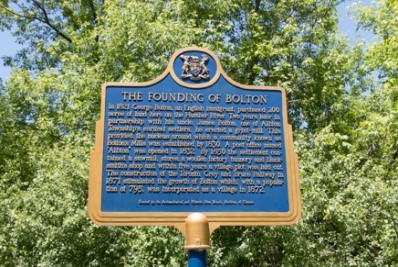
For the past two years, the Albion Bolton Historical Society has been anticipating the 200th Anniversary of Founder’s Day and has been working with Heritage Caledon and Town staff on the creation of an interpretive plaque to commemorate Bolton’s Bicentennial.
To this end, the Society has formed a Bicentennial Committee to oversee various activities. The Honorary Co-Chairs are Society members Isabelle Bottoms, a former teacher and descendent of the Bolton family, and Heather Broadbent, a noted local historian and former Town of Caledon Heritage Resource Officer. The steering committee includes members of both the Society and Heritage Caledon.
As a result of the pandemic, it is unlikely that there will be public recognition of this anniversary during 2021. The Society website will provide information as it becomes available.
June 5 marks 200 years since the founding of Bolton
Saturday June 5th marks the 200th anniversary of the purchase, by George Bolton, of a 200-acre mill site along the Humber River. He was 22 years old. The site’s potential had been identified by Provincial Land Surveyor James Chewett as he surveyed Albion Township in 1819 and was part of 2635 acres of land in Albion Township that Chewett received as payment for his services. George Bolton’s subsequent grist mill was the catalyst for our community. Here is what we know about him:
George Bolton was born in 1799 and grew up in Tannington, Suffolk England, not far from the Worlingworth church where his birth is registered. He was the youngest of six children born to James and Judith Bolton and he was educated, as were his siblings.
Although thought to be a bachelor, George had had a disagreement with his father over an unsanctioned marriage that, in the end, did not last. Written out of his father’s will, George left England and travelled to Jamaica where he acquired capital working in the indigo trade.
When George arrived in Canada in 1821, he was joining his brother, James Bolton, 18 years his senior and one of the first to settle in Albion Township. James’ 100-acre farm lay close to the Caledon King Town Line and Castlederg Sideroad. One of George’s first tasks was to build a house, later described as a frame, roughcast building. He also selected and started clearing a site for his grist mill on the south bank of the Humber. He was guided by James, a skilled millwright, who helped him build his mill and construct a dam across the river. The mill was grinding grain by 1824.
The economic value of the area surrounding George’s property had been recognized and the survey reserved the 200 acres to the south for the Clergy and the 200 acres to the west for the Crown. In addition, 1000 acres on the tableland, immediately north, were given, as an extraordinary land grant, to a high-ranking military officer, Robert Loring, who lived in Kingston. This created challenges for mill access since surrounding road allowances were not cleared or maintained by these ‘absentee’ landowners.
George was known to be very hospitable to the many farmers who brought grain to the mill. He must also have had strength, resilience and endurance. He persevered and was successful, thanks to the ever-growing demand for flour.
His closest neighbours were niece Harriet Bolton and her husband John Godbolt who settled on land George sold to them, north of the Humber, well east of what is now Humber Lea Road. By 1830, there were fewer than 10 people living in a one-kilometer radius of Bolton’s Mill.
Around 1830, George provided land and a log structure for a school and in 1831, built a store at the NE corner of what would be King Street East at Mill. The following year, the government appointed George as postmaster and he housed the post office, named ALBION, in his store. In the early 1830s, two of George and James’ sisters immigrated to Canada, also settling in Albion Township: Maria Bolton Fuller and her husband Samuel. Rachel Bolton Godbolt and her husband George. George Bolton did not take sides during the 1837 Mackenzie Rebellion unlike James who fled to the US in the aftermath because of his vocal and written support of the uprising.
In 1845, after 23 years as miller, George retired and sold the mill, house and other property to his assistant and nephew, James Bolton Jr. He died on November 16, 1869 in Glenville, near Newmarket, on the farm of James Bolton Jr. and his wife Ellen. Efforts to locate where he is buried have been unsuccessful.
Ray Bottoms
Sadly, our immediate past president, Ray Bottoms, passed away on January 3, 2021. Ray served as the president of the Albion Bolton Historical Society for over a decade. Ray was a strong supporter of the Society and will be missed.
We extend condolences to his wife Isabelle, their children and families. For a full obituary please see https://www.eganfuneralhome.com/raymond-charles-dennis-bottoms/
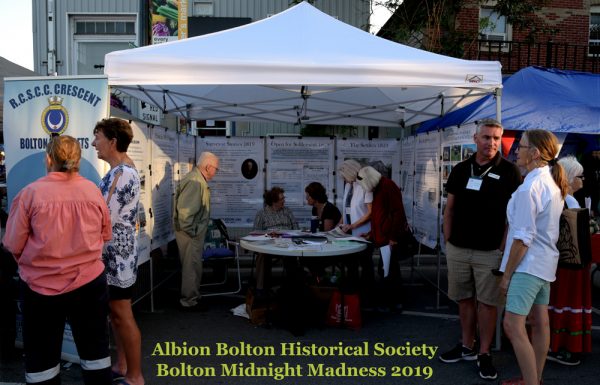

On April 18 2019 Caledon held its annual community Recognition Night. The Albion Bolton Historical Society was pleased to see four of our long term members receive Community Recognition Awards.
Doris Porter was named Community Champion for 2019. She received her award plaque and certificate from Mayor Allan Thompson and Dufferin-Caledon MPP Sylvia Jones. The Society respectfully notes the passing of Doris on November 21, 2019. She was a strong contributor to the Society and will be missed.

Volunteer Service Awards were given to Isabelle and Ray Bottoms and to Cy Wallace.


The Society congratulates and thanks these members for their support of the Society over many years.